
Let me start by saying something I tell parents at every Basking Babies session: you are already doing more than you think.
Why play matters more than you know
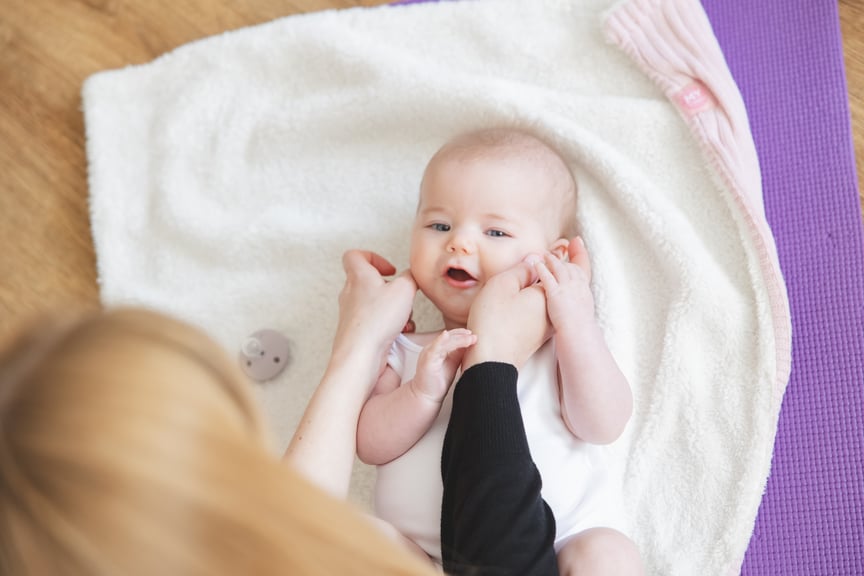
As a play therapist and teacher, I was trained to understand that play is a child's primary language. Long before they have words, babies communicate through eye contact, movement, sound, and touch. When you respond to those signals by mirroring their expressions, copying their babble, and following their gaze, you are literally building their brain.
This is called serve-and-return interaction, and it's the foundation of everything: language, emotional regulation, confidence, and connection.
What brain-supporting play looks like
Play doesn't need to be elaborate. In fact, the simplest interactions are often the most powerful.
Follow their lead
Babies are natural explorers. Instead of directing the play, watch what captures your baby's attention and join them there. If they're fascinated by a spoon, bang it with them. If they keep dropping a toy, pick it up - that game is developing their understanding of cause and effect.
In play therapy, we call this child-led play, and it's one of the most respectful and effective tools we have.
Talk (and sing) all the time
Narrating your day might feel silly, but it is genuinely one of the best things you can do for your baby's language development. "Now we're putting your socks on. One, two!" or "Can you hear the rain?" Every word you say is laying a foundation.
Songs are even better as the rhythm and repetition help babies recognise patterns, which is a core cognitive skill.
Make eye contact and respond
When your baby looks at you, look back, smile, and respond. That is a complete and perfect interaction. You don't need anything else in that moment. That serve-and-return exchange is building secure attachment, emotional intelligence, and social confidence.
Get on the floor
Tummy time, reaching, rolling, grasping... physical play is brain play. Every time your baby reaches for something, works out how to hold it, or figures out how to get to you, they are problem-solving. You are both their motivation and their safe base.

Peek-a-Boo is educational
I'm serious. Peek-a-boo teaches object permanence (the understanding that things continue to exist even when you can't see them), anticipation, and emotional regulation. It also makes babies laugh, which is wonderful for its own reasons.
A word about screen time (without the guilt)
I know this is a loaded topic. And I want to be honest with you rather than lecture you.
The reason experts recommend limiting screens in the very early years isn't because screens are evil. It's because they're passive - they don't respond to your baby. A video can't notice that your baby has lost interest, can't lean in when they seem excited, can't copy their funny face back to them.
You can. And that back-and-forth, that responsive relationship, is what the developing brain is hungry for.
If screens give you a moment to breathe, use them without shame. But when you're present and playful - even for ten minutes - you're giving your baby something a screen can't.
A little reassurance